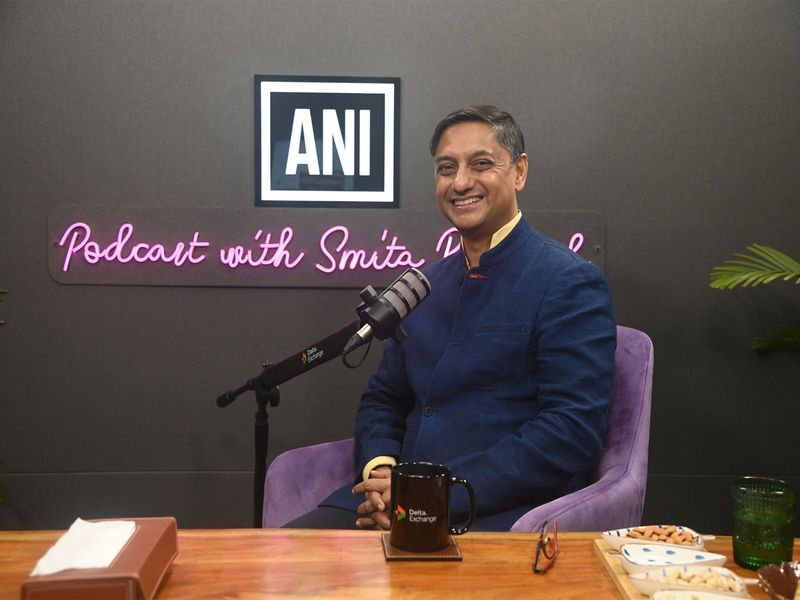
New Delhi [India], August 19 (ANI): India should not seek to defend the rupee against depreciation and should instead allow the currency to find its market-driven level while keeping inflation under control, Sanjeev Sanyal, Member of the Economic Advisory Council to the Prime Minister (EAC-PM), said in an interview with ANI.
Sanyal said India had chosen to focus on controlling inflation rather than targeting the rupee’s exchange rate. Under this approach, monetary policy should mainly aim to keep prices stable instead of trying to maintain the rupee at a specific level.
“When we decided to create an inflation targeting framework, then we clearly opted for monetary policy over exchange rate,” Sanyal said, explaining the trade-off faced by economies with open capital accounts.
He said India’s policy framework was based on the principle that a country cannot simultaneously exercise independent monetary policy and tightly control its exchange rate. According to Sanyal, India had therefore effectively given up on targeting the exchange rate when it adopted inflation targeting.
“Now, we have actually opted the other way, which is the right thing to do for a large internally oriented country, which is to target our inflation,” he said.
Sanyal emphasised that India should not interfere with the rupee’s ability to find its own level, pointing to the success of the inflation-targeting framework in keeping price pressures under control.
“I don’t think we should be interfering in allowing the rupee to find its own level because the inflation targeting system has actually worked very well. you will remember that inflation in India used to run in the 8% to 12% range. Today, inflation has been in the 2% to 6% range for the last decade.”
Sanyal, however, clarified that allowing the rupee to adjust does not mean that authorities should never intervene in the currency market. He said foreign exchange reserves could be used to moderate the pace of movements, but not to prevent the rupee from finding its market-driven level.
“It just means that we allow the exchange rate to adjust to the market-driven level. We can use the reserves to soften the direction in which it goes, but no more,” he said.
He argued that the effectiveness of inflation targeting was more important than defending a particular exchange-rate level, saying the key objective should remain domestic price stability.
Sanyal also rejected the idea that a weaker rupee is necessarily harmful for the economy, saying depreciation can provide greater space to exporters if inflation remains contained.
“If we control inflation at a decent level and the exchange rate weakens, well, many other countries in the world have exchange rates that move around quite a lot,” he said.
According to Sanyal, the key concern should be whether currency depreciation feeds into domestic inflation. If inflation remains under control, a weaker exchange rate can improve export competitiveness rather than automatically becoming a drag on the economy.
He further said the rupee’s depreciation should not be viewed in isolation from domestic price stability, noting that purchasing power parity would play a role over the longer term.
“If inflation spikes up, we will increase interest rates. So protecting the rupee is not the way to do it,” Sanyal said.
He also noted that India’s approach differed from China’s earlier deliberate currency depreciation, describing the Indian rupee’s movement as organic. The essential condition, he stressed, was maintaining control over inflation. (ANI)
(This content is sourced from a syndicated feed and is published as received. The Tribune assumes no responsibility or liability for its accuracy, completeness, or content.)