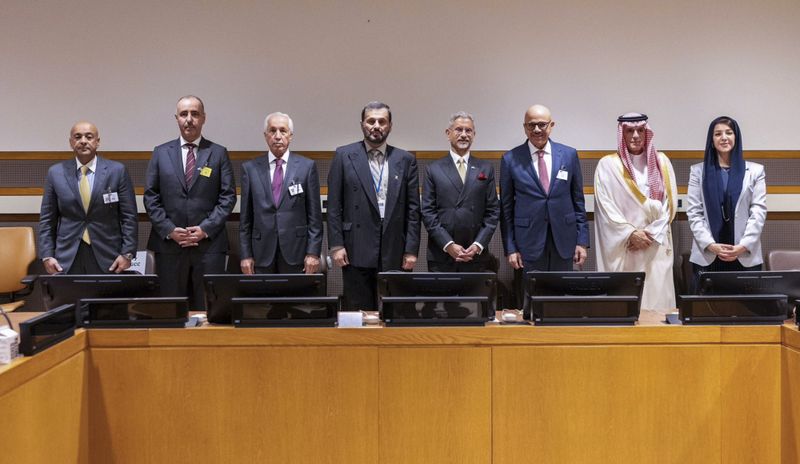
India and the Gulf Cooperation Council (GCC) have reaffirmed their commitment to deepening ties that have expanded well beyond energy and trade, as the two sides reviewed a broad cooperation agenda and underscored the growing importance of economic integration, the Ministry of External Affairs said here on Saturday.
The India-GCC Troika Ministerial Meeting, held on the margins of the 81st session of the United Nations General Assembly in New York, brought together senior foreign-policy officials from India and the six-nation Gulf grouping.
According to the Ministry, External Affairs Minister Dr S Jaishankar led the Indian delegation, while Bahrain Foreign Minister Dr Abdullatif bin Rashid Al Zayani, GCC Secretary General Jasem Mohamed Albudaiwi and Saudi Minister of State for Foreign Affairs Adel Al-Jubeir represented the GCC at the Troika level.
UAE Minister of State for International Cooperation Reem Al Hashimy, Qatar Minister of State for Foreign Affairs Sultan Al Muraikhi, Oman’s Ambassador Mohammed bin Abdullah Al Qutbi and Kuwait’s Assistant Minister for Foreign Affairs Hamad Al Marii also attended the meeting.
The meeting came against the backdrop of expanding India-Gulf ties, with trade, investment, energy, technology, healthcare and cultural exchanges emerging as key pillars of the partnership.
Bilateral trade between India and the GCC reached $178.66 billion in the financial year 2025-26.
Jaishankar highlighted the historically close and friendly ties between India and the Gulf countries, reinforced by extensive commercial links and strong people-to-people connections. The large Indian diaspora across the GCC remains an important link between the two regions.
FTA talks
A major focus of the meeting was the India-GCC Free Trade Agreement (FTA), negotiations for which were launched after the two sides finalised the Terms of Reference in February 2026.
The two sides welcomed the start of negotiations, noting that the agreement could help unlock the potential of bilateral trade, facilitate the expansion and diversification of exports and strengthen economic integration.
The FTA process marks a significant step towards giving greater structure and momentum to economic ties between India and the Gulf, where trade and investment have acquired growing strategic importance.
The ministers also reviewed progress under the India-GCC Joint Action Plan for 2024-28, adopted at the first India-GCC Joint Ministerial Meeting for Strategic Dialogue in Riyadh in September 2024.
The plan covers a wide range of areas — from political dialogue and security to trade, investment, agriculture, food security, transport, energy, health, culture and education. The two sides noted that the breadth of the agenda reflected the increasingly multifaceted nature of India-GCC relations and welcomed the progress made so far.
Energy security
Energy security too remained central to the discussions. Jaishankar thanked the GCC countries for continuing to supply energy and fertilisers to India despite disruptions to trade routes during the recent conflict in West Asia.
He also called for further strengthening the energy partnership, including through greater cooperation in renewables, biofuels and green technologies.
The ministers also discussed the wider security situation in West Asia and challenges to commercial shipping through international waterways.
India stressed the importance of regional peace and security and the need to use dialogue and diplomacy to resolve conflicts. The discussions also covered reform of multilateral institutions, sustainability and efforts to tackle terrorism.
Focus on people-to-people ties
Beyond economic and strategic interests, the two sides also emphasised strengthening people-to-people ties.
The ministers called for greater cooperation in arts, heritage, yoga, music, cinema and literature. Jaishankar appreciated the GCC countries for ensuring the welfare and safety of the Indian diaspora, particularly during the recent conflict in West Asia.
With millions of Indians living and working across the Gulf, the diaspora remains a vital link between India and the GCC and is deeply connected to the economic and social fabric of the region.
The meeting concluded with an agreement to convene the second India-GCC Joint Ministerial Meeting for Strategic Dialogue at an early date.