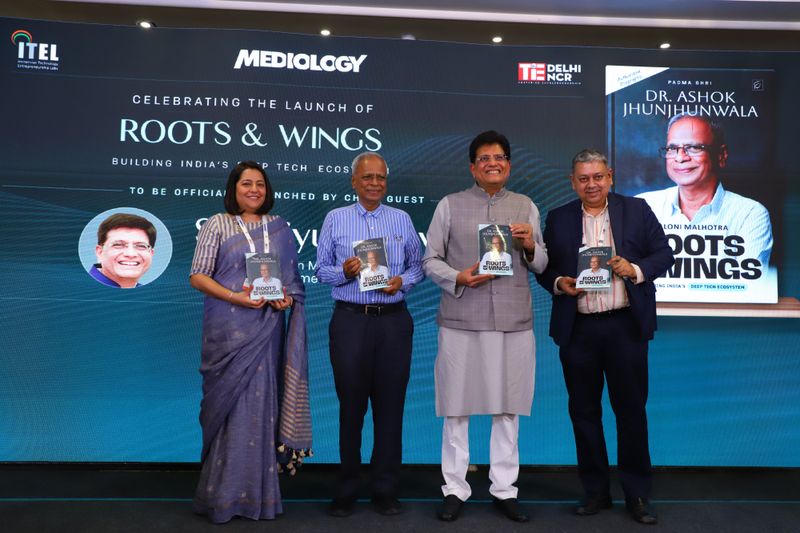
India’s deep tech pioneer and Padma Shri awardee Dr Ashok Jhunjhunwala has called for a radical overhaul of the country’s education system, urging policymakers to remove nearly 50% of school and engineering curricula and focus instead on teaching students how to learn, innovate and build.
Speaking at the launch of Roots & Wings: Building India’s Deep Tech Ecosystem, an authorised biography written by entrepreneur Saloni Malhotra, Dr Jhunjhunwala said educational institutions should prioritise creating builders rather than preparing students to pass examinations.
“We don’t need to teach to pass tests. Learn to build, build anything, build together,” he said, acknowledging that the view may be controversial but insisting it is necessary for India’s future.
The veteran technologist argued that India’s transformation will be driven not by a handful of unicorns but by millions of entrepreneurs. “Not 20, not 200, not even 2 million business owners. Is it possible to produce 20 million entrepreneurs? The nation will change if that happens,” he said.
Written by Saloni Malhotra, who first met Dr Jhunjhunwala in 2004 and later worked with him for seven years while building her startup, the book documents his ideas, struggles, institutions and the people shaped by his mentorship. It also traces how those efforts continue to fuel India’s deep tech ecosystem.
The biography chronicles Dr Jhunjhunwala’s journey since returning to India in 1981 and highlights four decades of institution-building, including the establishment of the IIT Madras Research Park, which transformed collaboration between academia and industry.
Explaining the park’s growth, he said easy funding can be detrimental. As a result, the research park declined government support and instead borrowed between Rs 300 crore and Rs 350 crore from banks. The loans were fully repaid, and the park generated a cash profit of Rs 80 crore.
According to Dr Jhunjhunwala, by June 2024 the ecosystem had helped build 350 companies with a combined valuation of about Rs 70,000 crore, while receiving only around Rs 2-3 crore in government funding.
His vision centred on connecting India’s 1.5 lakh scientists, many of whom focus on research publications, with talented 22-year-olds—particularly from middle- and lower-middle-class families—who are eager to create and innovate.
On artificial intelligence and technology, he noted that India continues to import critical technologies, including chips and battery cells. He urged the country to focus on solving its own challenges, such as traffic congestion, waste management, water pollution and fertiliser dependence, describing them as major opportunities for innovation.
Despite decades of achievements, Dr Jhunjhunwala said his mission remains incomplete. Having turned down IIT directorships and claiming no interest in fame, fortune or power, he said his ultimate goal is simple: “I want to see India change, India happy, at large scale.”
That future might come sooner than anticipated if his 20 million entrepreneurs respond to the call.