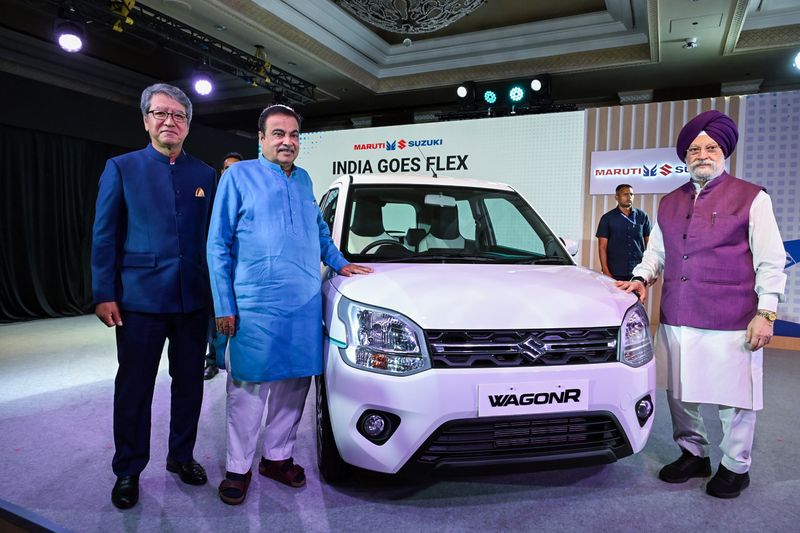
Maruti Suzuki on Thursday launched India’s first flex-fuel passenger vehicle, introducing a version of its Wagon R Flex Fuel capable of running on ethanol-petrol blends ranging from E20 to E100, as the country seeks to reduce crude oil imports and lower carbon emissions.
India has emerged as one of the countries with the minimal rise in fuel prices worldwide, with only Japan recording a lower increase, Petroleum and Natural Gas Minister Hardeep Singh Puri said on Thursday. He said India ranked second among 193 nations in controlling fuel price hikes, a feat achieved despite global geopolitical challenges.
Speaking at the launch of India’s first flex-fuel passenger vehicle by Maruti Suzuki, in the presence of Union Minister for Road Transport and Highways Nitin Gadkari, Puri said the government’s decision to reduce central excise duties on petrol and diesel by Rs 10 per litre was a key measure aimed at providing relief to consumers. He also highlighted India’s energy resilience, noting that before military hostilities began on February 28, nearly 60 per cent of the country’s LPG imports and 90 per cent of its crude oil imports transited through the Strait of Hormuz. He said despite this heavy dependence, India ensured uninterrupted availability of petroleum products across its extensive distribution network.
Puri outlined India’s three-pronged energy strategy — availability, affordability and sustainability. On availability, he highlighted the increase in domestic LPG production from 32 TMT per day pre-crisis to nearly 52 TMT per day, alongside the expansion of piped natural gas and CNG networks. On affordability, India recorded one of the lowest fuel price increases globally, he emphasised.
On the sustainability front, Puri spotlighted India’s ethanol blending programme, now considered one of the world’s most successful energy transition initiatives. Ethanol blending has surged from less than 1.5 per cent in 2013-14 to 20 per cent in 2025-26, reaching the target five years ahead of schedule. Ethanol production capacity has grown nearly five-fold, from 421 crore litres in 2014 to around 2,000 crore litres in 2026.
Puri further noted that if 50 per cent of new two- and four-wheelers shift to flex-fuel vehicles, it would generate an additional demand of 311.8 crore litres of ethanol, provide Rs 12,403 crore extra income to farmers and cut CO₂ emissions by 66.4 lakh metric tonnes.
The minister also outlined the government’s roadmap for creating a nationwide flex-fuel ecosystem. Under the proposed roadmap, E85 has been identified as the mono-fuel standard for flex-fuel vehicles (FFVs) under BIS specifications. The plan proposes an initial rollout of 50-100 FFV-ready fuel retail outlets in the Delhi-NCR and Mumbai-Pune-Nagpur corridors, expanding to nearly 500 outlets by December 2026 and approximately 5,000 outlets across major cities by end-2027.
The government is also working on supportive measures such as pricing support, road tax concessions, availability of E85 testing fuel, special identifiers for FFVs and retail outlets, consumer awareness initiatives, and development of storage and dispensing infrastructure to increase adoption.
Puri said this was not merely a transition in fuel, but it was the creation of a complete ecosystem for cleaner mobility, stronger energy security and greater self-reliance.