
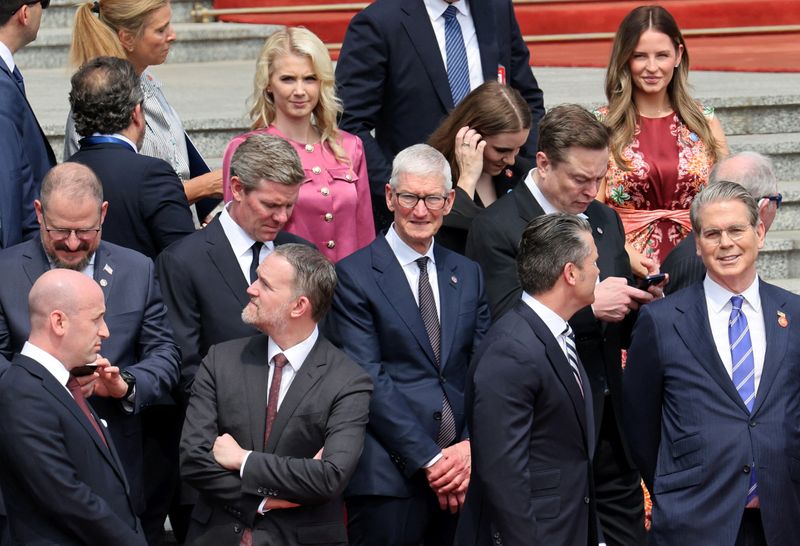
The anticipated meeting between Donald Trump and Xi Jinping has once again placed global trade, technology and geopolitics at the centre of international attention, with some of the world’s biggest business leaders closely watching every signal emerging from Washington and Beijing.
From Elon Musk to Tim Cook, several influential corporate leaders have massive business interests tied to China — the world’s second-largest economy and a critical manufacturing and consumer market.
Why China matters to global CEOs
For companies such as Tesla and Apple, China is not just a market but also a manufacturing backbone.
Tesla’s Shanghai Gigafactory remains one of the company’s most productive facilities globally, while Apple continues to depend heavily on Chinese manufacturing partners despite efforts to diversify production to countries like India and Vietnam.
Other prominent global business leaders with deep China ties include:
Jensen Huang of NVIDIA
Jamie Dimon of JPMorgan Chase
Satya Nadella of Microsoft
Howard Schultz linked with Starbucks’ expansion in China
Cristiano Amon of Qualcomm
Sanjay Mehrotra, CEO at Micron Technology
China remains one of the biggest revenue generators for luxury brands, automobile giants, semiconductor companies and global banks.
Why the Xi-Trump equation is controversial
The possible Xi-Trump engagement comes amid worsening US-China tensions over trade tariffs, semiconductor restrictions, Taiwan, artificial intelligence, cybersecurity and military influence in the Indo-Pacific region.
Trump has repeatedly accused China of unfair trade practices and has threatened fresh tariffs if re-elected, while Beijing has criticised Washington’s export controls and restrictions on advanced chip technologies.
The controversy deepened after Trump allies pushed for tougher measures against Chinese electric vehicles, battery makers and tech companies, arguing that China poses both an economic and national security challenge.
At the same time, several American CEOs have been accused domestically of being “too dependent” on China because of their business interests there.
Musk, in particular, has faced criticism from some US lawmakers over Tesla’s extensive operations in China and his comments perceived as being soft on Beijing.
Why the world is watching
A Xi-Trump understanding or confrontation could directly impact global markets, supply chains, oil prices and investor confidence.
Any escalation between the world’s two biggest economies could affect sectors ranging from semiconductors and AI to electric vehicles and rare earth minerals.
Countries in Europe, Southeast Asia and the Gulf are also closely monitoring the developments because both the US and China remain key economic partners.
India’s balancing act
For India, the Xi-Trump dynamics carry both risks and opportunities.
On one hand, worsening US-China tensions have helped India position itself as an alternative manufacturing hub, with companies like Apple gradually shifting portions of iPhone production to India.
On the other hand, any sharp global slowdown or trade war could hit Indian exports, stock markets and energy prices.
India is also carefully navigating its strategic partnerships with the US while managing its complex relationship with China, especially after border tensions in eastern Ladakh.
New Delhi’s approach has largely focused on economic pragmatism — attracting global supply chains leaving China while avoiding direct entanglement in US-China rivalry.
As geopolitical tensions reshape global business, the Xi-Trump equation is increasingly being viewed not just as a political development, but as a defining factor for the future of international trade, technology and economic power.
